> ## Documentation Index
> Fetch the complete documentation index at: https://docs.ntop.com/llms.txt
> Use this file to discover all available pages before exploring further.
# Modal Analysis
***
## About this Block
**What it does:** Runs an analysis on an [**Simulation Model**](/block-documentation/blocks/structures/model/simulation-model.html) that calculates its natural frequencies (eigenfrequencies) and their corresponding mode shapes.
**Common uses:**
* Understanding the vibrational characteristics of your model.
**Tips:**
* Free modes of vibration calculations don't consider forces. Therefore, we don't need to use them in the boundary conditions.
* Run free-free modal analysis by not providing any Restraints.
* You can bound the minimum and maximum frequencies, but it will return an error if there are no natural frequencies in that range.
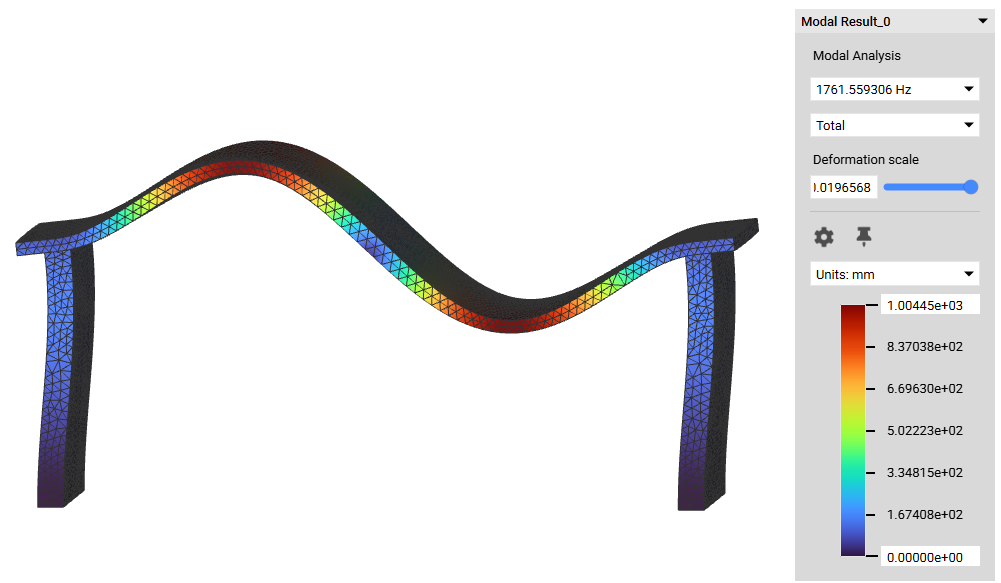
* When the calculation is complete, a Head's Up Display (HUD) will appear that allows you to visualize the block's results. The block's visibility must be on to see the results window.
* You can change the min and max values in the colormap by clicking on their values.
* The "Deformation scale" controls the exaggeration of the displacement for visual inspection.
* To access the eigenfrequencies, open the Info Panel > Properties. Scroll down and expand the eigenfrequencies. Drag these into the Notebook to use the values.
* It is recommended to use a Quadratic Geometric order FE Mesh with any analysis to get the most accurate results.
## Example File
Download Example: [Modal Analysis](https://storage.googleapis.com/files-learn/static/ExtendedBlockDocs/modal_buckling_analysis.ntop)
***
FE Model, Restraints, Integer, Scalar, Scalar
Calculate the natural frequencies and mode shapes of an FE Model subject to prescribed boundary conditions. This block calculates a specified number of vibration modes. Providing minimum and maximum frequencies bounds the range of frequencies to be returned. Removing the optional Restraints input leads to a free-free Modal Analysis.
### Inputs
| Name | Type | Description |
| - | - | - |
| Model | [FE Model](../../../../block-documentation/types/fe-model) | The finite element model. |
| Restraints | [Boundary Condition List](../../../../block-documentation/types/boundary-condition) | The displacement restraints. |
| Number of modes | [Integer](../../../../block-documentation/types/integer) | Maximum number of modes to calculate. |
| Min frequency | [Scalar](../../../../block-documentation/types/scalar) | Lower bound of returned frequencies. |
| Max frequency | [Scalar](../../../../block-documentation/types/scalar) | Upper bound of returned frequencies. |
### Outputs
| Type |
| - |
| [Modal Result](../../../../block-documentation/types/modal-result) |
***
FE Model, Restraints, Integer, Scalar, Scalar, 1.1.0
Calculate the natural frequencies and mode shapes of an FE Model subject to prescribed boundary conditions. This block calculates a specified number of vibration modes. Providing minimum and maximum frequencies bounds the range of frequencies to be returned. Removing the optional Restraints input leads to a free-free Modal Analysis.
### Inputs
| Name | Type | Description |
| - | - | - |
| Model | [FE Model](../../../../block-documentation/types/fe-model) | The finite element model. |
| Restraints | [Boundary Condition List](../../../../block-documentation/types/boundary-condition) | The displacement restraints. |
| Number of modes | [Integer](../../../../block-documentation/types/integer) | Maximum number of modes to calculate. |
| Min frequency | [Scalar](../../../../block-documentation/types/scalar) | Lower bound of returned frequencies. |
| Max frequency | [Scalar](../../../../block-documentation/types/scalar) | Upper bound of returned frequencies. |
### Outputs
| Type |
| - |
| [Modal Result](../../../../block-documentation/types/modal-result) |
***
FE Model, Restraints, Integer, Scalar, Scalar, 1.2.0
Calculate the natural frequencies and mode shapes of an FE Model subject to prescribed boundary conditions. This block calculates a specified number of vibration modes. Providing minimum and maximum frequencies bounds the range of frequencies to be returned. Removing the optional Restraints input leads to a free-free Modal Analysis.
### Inputs
| Name | Type | Description |
| - | - | - |
| Model | [FE Model](../../../../block-documentation/types/fe-model) | The finite element model. |
| Restraints | [Boundary Condition List](../../../../block-documentation/types/boundary-condition) | The displacement restraints. |
| Number of modes | [Integer](../../../../block-documentation/types/integer) | Maximum number of modes to calculate. |
| Min frequency | [Scalar](../../../../block-documentation/types/scalar) | Lower bound of returned frequencies. |
| Max frequency | [Scalar](../../../../block-documentation/types/scalar) | Upper bound of returned frequencies. |
### Outputs
| Type |
| - |
| [Modal Result](../../../../block-documentation/types/modal-result) |
***
FE Model, Restraints, Integer, Scalar, Scalar, 1.3.0
Calculate the natural frequencies and mode shapes of an FE Model subject to prescribed boundary conditions. This block calculates a specified number of vibration modes. Providing minimum and maximum frequencies bounds the range of frequencies to be returned. Removing the optional Restraints input leads to a free-free Modal Analysis.
### Inputs
| Name | Type | Description |
| - | - | - |
| Model | [FE Model](../../../../block-documentation/types/fe-model) | The finite element model. |
| Restraints | [Boundary Condition List](../../../../block-documentation/types/boundary-condition) | The displacement restraints. |
| Number of modes | [Integer](../../../../block-documentation/types/integer) | Maximum number of modes to calculate. |
| Min frequency | [Scalar](../../../../block-documentation/types/scalar) | Lower bound of returned frequencies. |
| Max frequency | [Scalar](../../../../block-documentation/types/scalar) | Upper bound of returned frequencies. |
### Outputs
| Type |
| - |
| [Modal Result](../../../../block-documentation/types/modal-result) |
This documentation is built and hosted on [Mintlify](https://mintlify.com), a developer documentation platform.