> ## Documentation Index
> Fetch the complete documentation index at: https://docs.ntop.com/llms.txt
> Use this file to discover all available pages before exploring further.
# Robust Tetrahedral Mesh
***
## About this Block
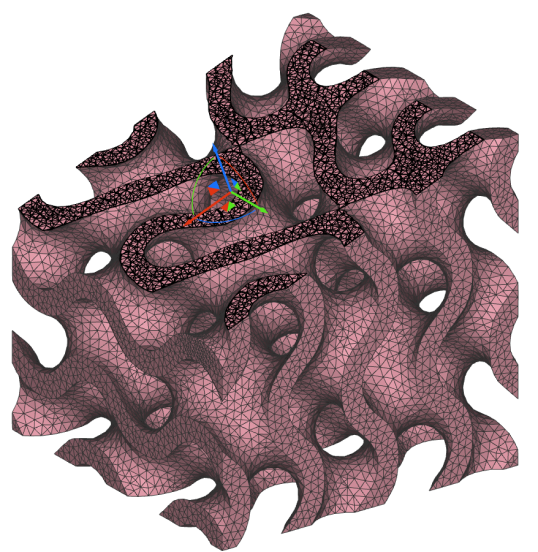
**What it does:** Creates a solid mesh from a surface mesh using a robust algorithm. It is tolerant of very low-quality inputs, converting them into FEA quality elements. This block can handle complex parts but is slower than the **Volume Mesh** block.
**Commons uses:**
* Converting complex surface meshes into solid meshes.
**Tips:**
* Edge length isn't a Scalar Field input. Therefore, it can't vary throughout the mesh.
* Use the **Remesh Surface** block to clean up the mesh before using the **Robust Tetrahedral Mesh** block. When doing this, use the same Edge length in both blocks to easily create the 3D elements.
* If your part isn't that complex, we recommend using the **Volume Mesh** block for faster results.
## Example File
Download Example: [Robust Tetrahedral Mesh](https://storage.googleapis.com/files-learn/static/ExtendedBlockDocs/robust_tetrahedral_mesh.ntop)
***
Mesh, Scalar, Integer, Scalar, 2.0.0
Mesh a solid domain with tetrahedral elements using algorithms that are tolerant to defects such as self-intersections. This function will remesh the boundary of the input domain to generate valid, high-quality elements. If the input domain is likely to be free of any defects, consider using the faster Volume Mesh block.
### Inputs
| Name | Type | Description |
| - | - | - |
| Domain | [Mesh](../../../../block-documentation/types/mesh) | The domain to mesh. |
| Edge length | [Scalar](../../../../block-documentation/types/scalar) | The target edge length of the generated elements. |
| Regularity factor | [Integer](../../../../block-documentation/types/integer) | A number between 0 and 10 indicating the level of mesh optimization that will be done to improve the shape of the tets. A value of 0 indicates a minimum amount of optimization and a value of 10 indicates a high amount of optimization to achieve regular shaped tetrahedra. |
| Tolerance | [Scalar](../../../../block-documentation/types/scalar) | A tolerance that controls how closely the output mesh vertices must be to the input surface. If not provided, a default value is derived by multiplying the diagonal of the bounding box of the input geometry by 0.001. |
### Outputs
| Type |
| - |
| [Volume Mesh](../../../../block-documentation/types/volume-mesh) |
***
Mesh, Scalar, Integer, Scalar, 2.1.0
Mesh a solid domain with tetrahedral elements using algorithms that are tolerant to defects such as self-intersections. This function will remesh the boundary of the input domain to generate valid, high-quality elements. If the input domain is likely to be free of any defects, consider using the faster Volume Mesh block.
### Inputs
| Name | Type | Description |
| - | - | - |
| Domain | [Mesh](../../../../block-documentation/types/mesh) | The domain to mesh. |
| Edge length | [Scalar](../../../../block-documentation/types/scalar) | The target edge length of the generated elements. |
| Regularity factor | [Integer](../../../../block-documentation/types/integer) | A number between 0 and 10 indicating the level of mesh optimization that will be done to improve the shape of the tets. A value of 0 indicates a minimum amount of optimization and a value of 10 indicates a high amount of optimization to achieve regular shaped tetrahedra. |
| Tolerance | [Scalar](../../../../block-documentation/types/scalar) | A tolerance that controls how closely the output mesh vertices must be to the input surface. If not provided, a default value is derived by multiplying the diagonal of the bounding box of the input geometry by 0.001. |
### Outputs
| Type |
| - |
| [Volume Mesh](../../../../block-documentation/types/volume-mesh) |
***
Mesh, Scalar, Scalar, Regions
Tetrahedralize a domain that may contain flaws in the input geometry.
### Inputs
| Name | Type | Description |
| - | - | - |
| Domain | [Mesh](../../../../block-documentation/types/mesh) | The domain to mesh. |
| Edge length | [Scalar](../../../../block-documentation/types/scalar) | The target edge length of the generated elements. |
| Tolerance | [Scalar](../../../../block-documentation/types/scalar) | A tolerance that controls how closely the output mesh vertices must be to the input surface. If not provided, a default value is derived by multiplying the diagonal of the bounding box of the input geometry by 0.001. |
| Regions | [Mesh List](../../../../block-documentation/types/mesh) | Regions whose boundaries will be included in the output mesh. |
### Outputs
| Type |
| - |
| [Volume Mesh](../../../../block-documentation/types/volume-mesh) |
This documentation is built and hosted on [Mintlify](https://mintlify.com), a developer documentation platform.